Founded in December 2023 after four years of pioneering R&D in applied epitranscriptomics for diagnostics, Cyberna emerged from EPITRANSDIAG, a multidisciplinary collaboration advancing RNA modification research.
The company combines leading expertise in epitranscriptomics, AI, and clinical sciences with biotech entrepreneurial experience to accelerate innovation and unlock new biological insights.
Our mission is to develop innovative, highly sensitive, and accessible screening tools for patients and healthcare providers, enabling timely and accurate action to transform cancer care and significantly improve outcomes.
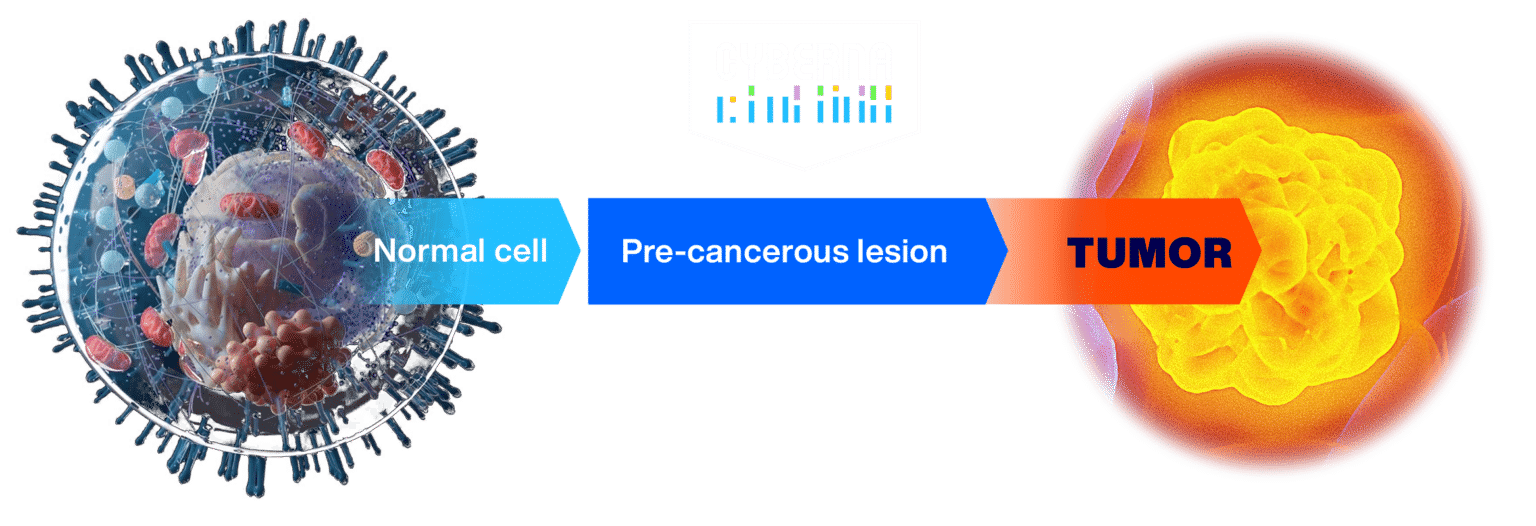
At Cyberna, we believe early detection is the most effective therapy: identifying cancer at a subclinical stage allows intervention before tumor development.
Half of cancers in the world are
detected too late.
Late diagnosis limit options
Pre-tumoral detection
Upstream of tumor-based diagnostics
Earlier than traditional liquid biopsy approaches (ctDNA, CTCs)
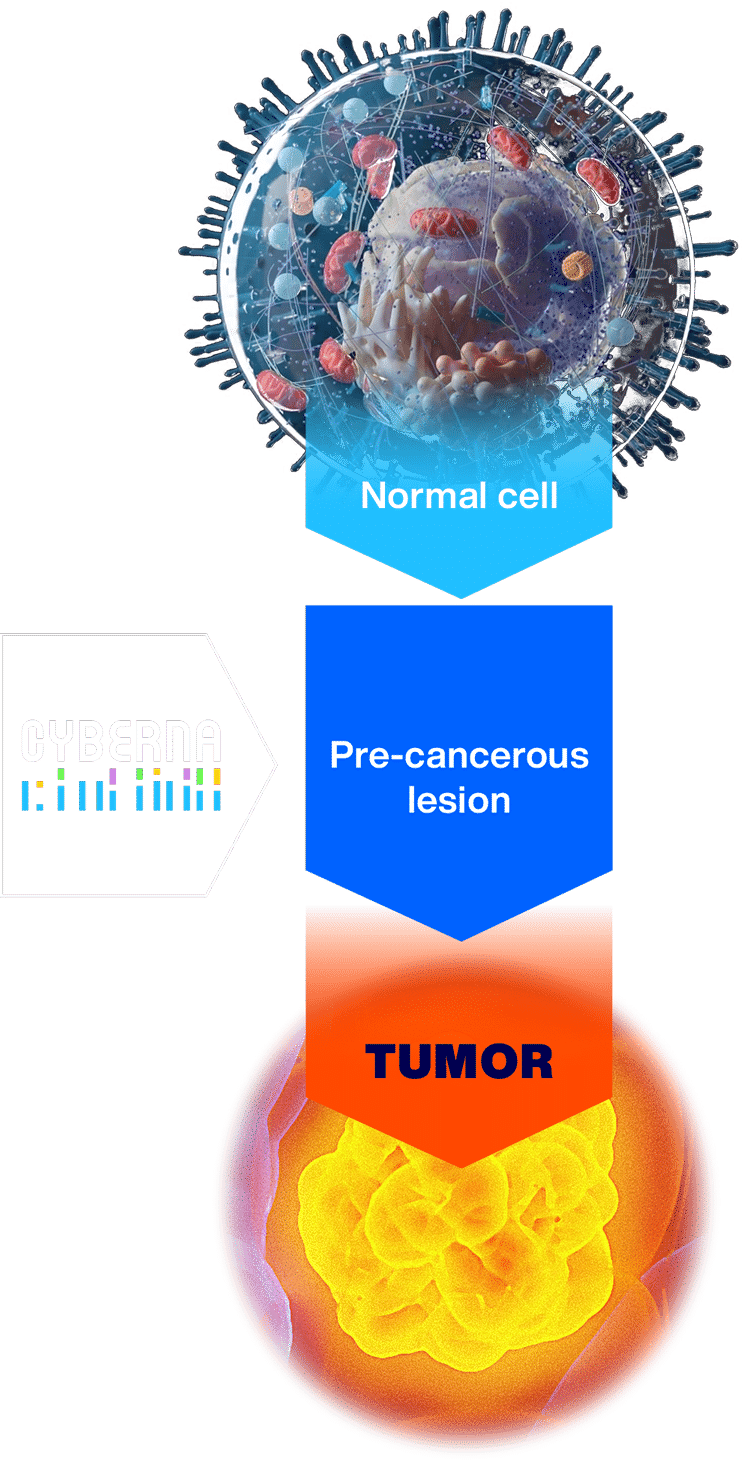
Cancer doesn’t start with a tumor. Neither do we.
Cyberna focuses on the process, not the event.
By detecting early molecular shifts in the cellular environment, we enable intervention before cancer becomes visible
Detects subtle changes in the cell environment
before tumor formation: Epitranscriptome
→ Captures the shift before disease starts
→ Enables action before cancer develops
Detects subtle changes in the cell environment
before tumor formation: Epitranscriptome
Requires tumor to exist
Detection often too late
Cyberna explores a largely untapped layer of biological information: the epitranscriptome.
More than 170 chemical modifications of RNA together form a dynamic barcode superimposed on the genome, allowing cells to adapt in real time to metabolic and environmental changes.
Cancer rewrites this barcode early, as the epitranscriptomic landscape shifts well before a tumor becomes visible. When modified RNA degrades, its distinctive nucleosides are not recycled but passively released into the bloodstream; their identity and relative abundance therefore act as an early biological signal, detectable before a tumor can be clinically identified.
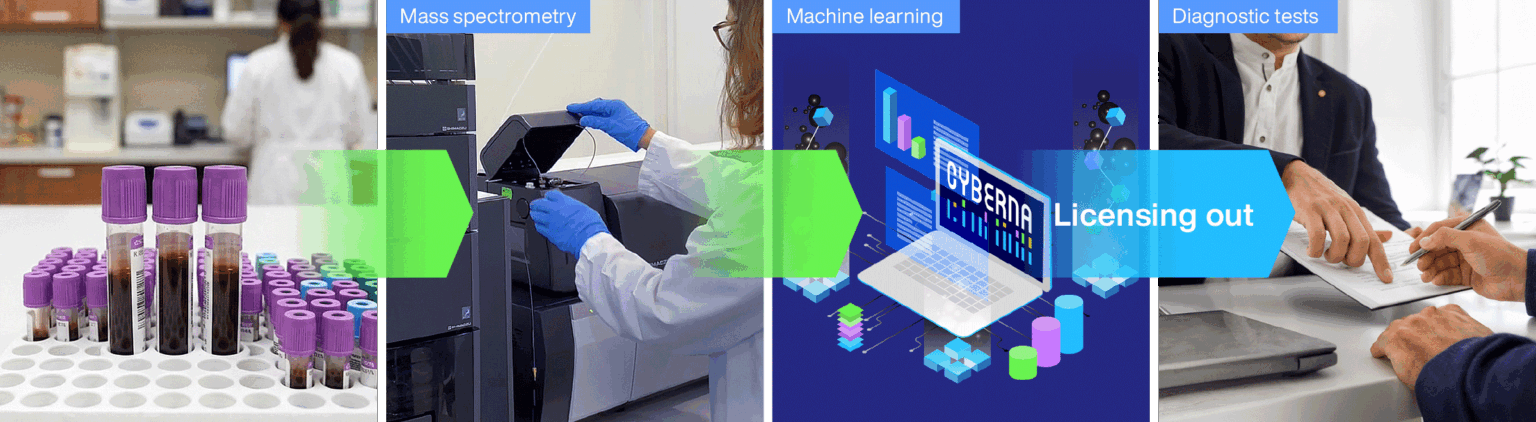
From complex biology to minimal, actionable signatures: our platform combines multiplex mass spectrometry and machine learning to identify and patent the minimal combination of nucleosides required to discriminate between clinical conditions (e.g. cancer vs. non-cancer).
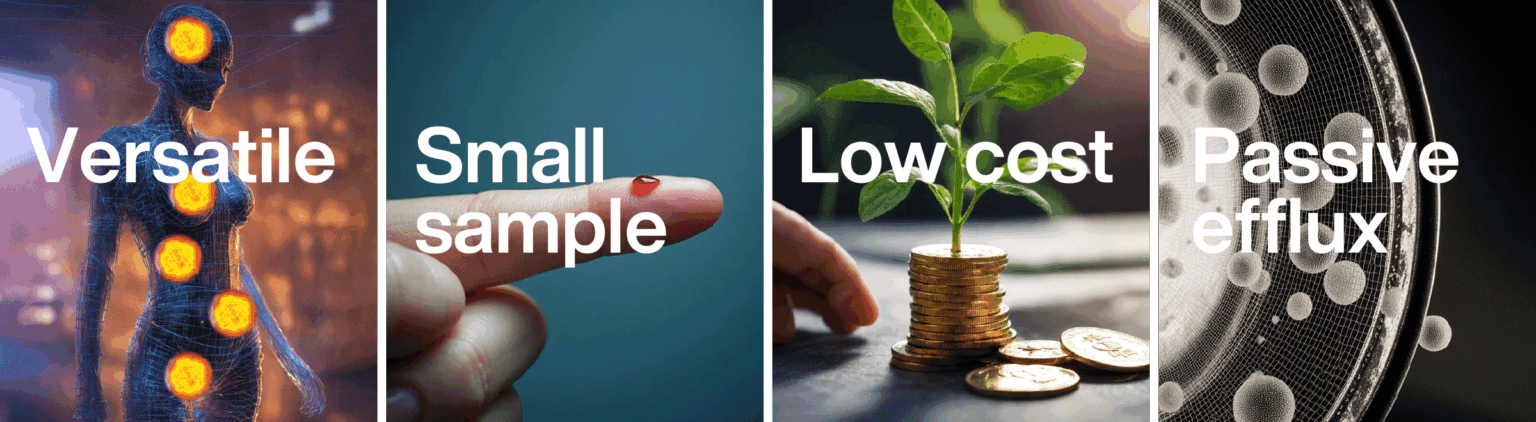
One versatile platform, all cancer types: a single workflow applicable across all cancer types, enabling the development of biomarker signatures for multiple clinical applications.
Minimal blood, maximum insight: requires only a droplet-equivalent volume of blood, enabling home sampling and making large-scale screening truly accessible.
Designed for affordability: ~10× more cost-effective than sequencing-based approaches, a critical advantage for population-level screening.
Unlocks the limits of traditional liquid biopsy approaches: not limited by tumor size or by the tumor’s ability to release ctDNA or circulating tumor cells, a major limitation of many liquid biopsy technologies.

Patrice GARNIER, Ph.D
CEO
Biotech Entrepreneur
20 years’ experience
(Stellate Therapeutics, Meletios)
Agnès MARTINEC, Ph.D
COO
Diag Industry
24 years’ experience
(Ipsogen, Qiagen, HalioDx, nexialist)
INSERM
Alexandre DAVID
R&D – Expert
RNA Chemistry
Oncology- IRCM
CHU MONTPELLIER
Christophe HIRTZ
R&D – Expert
Mass Spectrometry
IRMB-PPC
CNRS
Eric RIVALS
R&D – Expert
Artificial Intelligence
LIRMM
Pierre LAURENT-PUIG
GI oncology expert
President
Cancéropôle IDF
Olivier GLEHEN
GI oncology expert
Surgery Lyon (HCL)
Director CICLY
Catherine ALIX-PANABIERES
Liquid Biopsy Expert
CHU de Montpellier
Dir. LCCRH
Reuven AGAMI
RNA Expert
Netherlands Cancer
Institute (NKI)


CYBERNA
Institut Médecine Régénératrice & Biothérapie
Bat CYBORG, 80 avenue Augustin Fliche, Hôpital Saint Eloi
34 295 MONTPELLIER – FRANCE